
A Cognitive Perspective on Information Frictions in Labor Markets
Published in Entropy, 2025
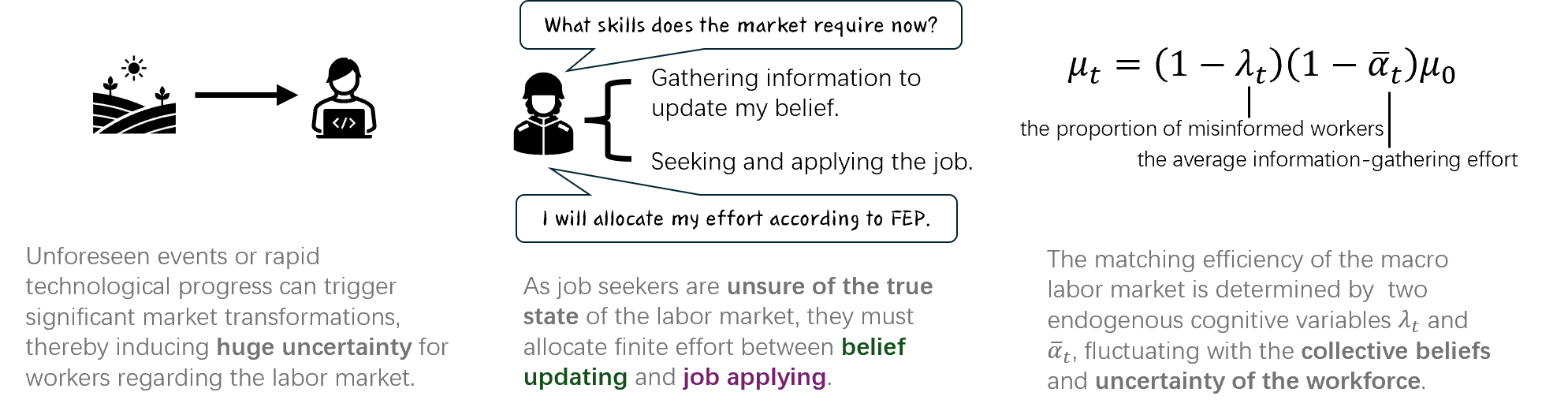
During the Great Recession, labor markets often exhibit a slow unemployment recovery and persistent outward shifts in the Beveridge curve, which suggests a decline in the efficiency of the job-matching process. While it is often explained by worker search intensity, we argue that the direction of search behavior also matters by proposing a stylized theoretical model based on the Free Energy Principle. Through modeling agents who actively divide their effort between applying for jobs and learning about the market’s new state, our framework shows that agents endogenously shift effort from applications to learning when their uncertainty is high. Building on this micro-foundation, we design a macroeconomic model where matching efficiency is no longer an external parameter but is instead governed by two cognitive factors: the share of unemployed workers with misaligned beliefs and the average learning effort of the informed. Simulation results show that a structural shock will divert effort to learning and depress matching by creating widespread uncertainty, and the subsequent slow recovery is governed by the realignment of collective beliefs. Our work provides a cognitive explanation for this observed persistence of unemployment and the shift of the Beveridge curve.
Recommended citation: Zhang, Zeqiang; Chen, Ruxin. (2025). "A Cognitive Perspective on Information Frictions in Labor Markets" Entropy. 27(12).
Download Paper